
How an Induction Stove Heats Without Fire — Magnetic Field Explained
Induction cooking looks like magic: the pan heats, but the plate stays almost cool. There’s no flame, no glowing coil — just **science**. This article explains the physics in plain language, shows an animated diagram of the magnetic field and eddy currents, gives buying tips, and shows recommended products you can link to.
Learn how an induction stove heats without fire using magnetic fields and eddy currents. Simple explanation with animations, diagrams, tips & best picks.
In one line — what's happening?
An induction stove uses an alternating magnetic field generated by a coil under the glass surface. That changing field induces **tiny electric currents** (called *eddy currents*) in the **metal base of the cookware**. Those currents produce heat *inside the pan itself* — so the pan becomes the heat source, not the stove.
Top Induction Stoves & Cookware
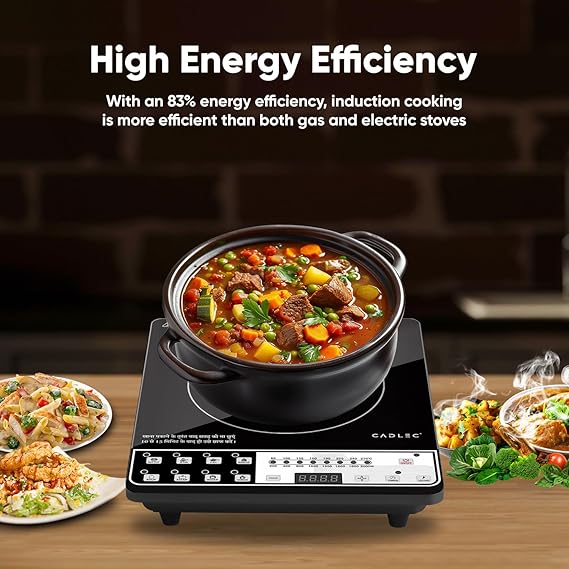


Animated Diagram — See the Magnetic Field & Eddy Currents
The SVG below visualizes: coil → alternating magnetic field lines → induced eddy currents in the pan (heat animation).
Animated magnetic field + heat waves.
Step-by-step — the physics (simple)
- AC power flows through the coil: An alternating current (usually 20–100 kHz in many stoves, but typical consumer stoves use a few kHz) passes through a copper coil under the glass plate.
- Changing magnetic field forms: Alternating current creates a magnetic field that keeps reversing direction. This is the key — a steady field would do nothing useful here.
- Eddy currents are induced: According to Faraday’s law, a changing magnetic field induces electric currents in conductive materials placed over it — the cookware base. Those are the eddy currents.
- Eddy currents create heat inside the pan: The induced currents flow within the metal of the pan and meet resistance, producing heat (I²R losses). This is why the pan gets hot but the glass top stays relatively cool.
- Heat cooks the food: Heat from the pan transfers to the food by conduction — the cooking is efficient because heat is made right in the cookware.
Why induction is efficient (and what people get wrong)
- High efficiency: Most of the electrical energy becomes heat in the pan, so less waste compared to coil or gas losses.
- Fast heating: Induction heats pans quicker than many electric coils and is competitive with gas for many tasks.
- Safer: No open flame; the glass surface remains cooler, reducing burn risk.
- Precise control: Rapid response to power changes — you can simmer or boil quickly.
- Myth — “Induction cooks the food without heat”: Not true: heat is generated, but inside the pan instead of from a flame or hot plate.
Quick Cost Calculator: Induction vs Gas (Approx)
Compare cost per hour of cooking. (Replace values with local prices.)
Choosing the Right Induction Stove — Quick Tips
- Choose correct wattage: 1500–2000W is ideal for most households.
- Look for auto-pan detection and child lock features.
- Prefer glass-top with good ventilation under the unit for longevity.
- Buy induction-compatible cookware (magnetic base). Test with a magnet.
- Check warranty & service network in your city.
FAQ
Is induction cooking safe for electronics or pacemakers?
Can I use any pan on induction?
Does the glass top break if I drop something?
(When technology and wisdom combine, cooking becomes easier.)
